
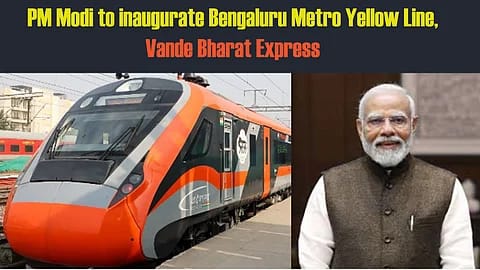
Today’s Top News Today, the garden city is abuzz with excitement as Prime Minister Modi takes centre stage in Bengaluru. All eyes are on Ragigudda, where Prime Minister Narendra Modi will formally inaugurate the much-awaited Yellow Line of the Namma Metro, as the Karnataka capital gears up for a major infrastructure milestone. This is not just another political visit, rather, it is a time of urban transformation for one of India’s most dynamic cities. The inauguration of the Yellow Line marks a new chapter in Bengaluru’s public transport history, reducing congestion and improving economic conditions.
Also, Prime Minister Modi’s presence in Bengaluru serves as a powerful reminder of the central government’s support for smart city development. Let’s get into the specifics of this momentous occasion.
All the points in this post
PM Modi in Bengaluru to Launch the Yellow Line
The inauguration of the 18.8 km long Yellow Line, which connects Ragigudda and Bommasandra, is the highlight of the day. HSR Layout, Bommanahalli and Electronic City are the key residential and IT hubs that will be served by this corridor. These areas have long experienced traffic congestion and poor connectivity. Prime Minister Modi’s participation in the inauguration in Bengaluru highlights the significance of the urban transport project for the nation. The Yellow Line is expected to benefit over 3 lakh commuters daily, significantly reducing travel time and road dependency.
If you use public transportation or plan to in the future, keep an eye out for this new lifeline.
Operations Begin on Monday – What That Means for Commuters
Although the inauguration is today, Monday will be the first working day. This will give time for Bengaluru Metro Rail Corporation Limited (BMRCL) staff training and final safety checks. Once it is inaugurated, the Yellow Line will run every 10 minutes during peak hours and every 15 minutes during off-peak hours. This is a change for the daily commuters stuck in traffic jams in Bengaluru. Also, the launch of this service by PM Modi in Bengaluru sends a clear message that sustainable and efficient public transport is the way forward for Indian cities.
CM Siddaramaiah and Dy CM Shivakumar to Join PM?
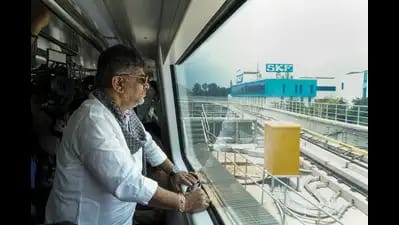
Yes, both Deputy Chief Minister D.K. and Chief Minister Siddaramaiah. Shivakumar are said to be accompanying PM Modi in Bengaluru for the inauguration. Despite the political differences between the BJP-led central administration and the state Congress government, their presence highlights the collaborative nature of the project. This is a once-in-a-lifetime display of unity, which shows that progress can transcend party lines. The welcome given to Prime Minister Modi in Bengaluru has clearly conveyed the significance of this project to the state’s top leaders.
Security and Traffic Arrangements in Full Swing
With Prime Minister Modi in Bengaluru, security in the city has been beefed up. Over 5,000 police officers are on duty and several public transport routes have been closed towards Ragigudda. Also, intelligence agencies and the National Security Guard (NSG) are on high alert. Alternate routes or public transport have been advised for travellers. Special shuttle services have been announced by BMRCL to facilitate people’s travel to the inauguration venue.
Yellow Line A Boon for Bengaluru’s IT Corridor
Over 400 technology companies are located in the Electronic City, which is connected to the metro network via the Yellow Line. Employees on HSR Layout and Sarjapur Road will no longer have to rely on closed roads or unorganised taxi services to commute to work. Real estate industry experts expect property values along the corridor to increase. On the other hand, the environment will benefit from fewer cars, which means lower emissions and a step towards a greener Bengaluru.
10 Things to Know While PM Modi is in Bengaluru
Here are 10 important things PM Modi said in Bengaluru today – The venue of the event is Ragigudda, which makes it easy for dignitaries to reach there. The effective inauguration of the Yellow Line is on Monday. PM Modi will be accompanied by eminent guests Deputy Chief Minister Shivakumar and Chief Minister Siddaramaiah. As per traffic guidelines, important roads near the venue may be temporarily closed. Access for the public is limited, but some convenient places are open for the public. Media coverage, national news channels are broadcasting live. Public participation, visitors are given introductory leaflets and souvenir booths.
Security alert, increased vigilance in sensitive city areas. Local politics, Jammu and Kashmir Congress is pressing for statehood in the backdrop. Economic improvement, connectivity and value for money for commuters through metro expansion. So if you are in Bengaluru right now, expect PM Modi buzz wherever you go in Bengaluru.
What Makes the Yellow Line Special?
The Yellow Line has several smart features besides connectivity – solar-powered stations to reduce carbon emissions, coaches exclusively for women and enhanced safety measures, seamless integration with upcoming metro lines and BMTC buses. AI-based crowd management and digital ticketing system. These improvements reflect Prime Minister Modi’s vision for Bengaluru, which included not only launching a metro line but also setting a standard for Indian urban transport.
Political Significance of PM Modi in Bengaluru
Today’s visit is significant from both a political and infrastructural perspective. As Congress leaders step up their campaign, Karnataka, a state with a significant opposition presence, is increasingly demanding restoration of statehood for Jammu and Kashmir. It is possible that PM Modi’s visit to Bengaluru was not a coincidence. By launching a major project in a Congress-ruled state, the PM is sending two messages: the Centre is committed to development regardless of political affiliation and infrastructure expansion is still a national priority. The Centre emphasises on the financial and technical assistance provided by the central government, while the state government blames its administration for the completion of the project.
Public Reaction: Excitement Meets Skepticism
The all-new metro line has Bengaluruans excited. Posts with the hashtags #NammaMetroYellowLine and #PMModiInBengaluru are all over social media. Many are hailing it as a “lifeline” for the southern suburbs. However, doubts remain. According to critics, the third phase of the metro project is still behind schedule and last-mile connectivity is still a challenge. Others question whether daily wage workers will be able to afford the cost of the metro. Still, sentiment is generally positive. “Finally, after years of potholes and congestion, we have a real solution,” says one commuter. “Thanks to Prime Minister Modi in Bengaluru, we are moving forward – literally.”
Environmental and Economic Impact
The Yellow Line is expected to reduce carbon dioxide emissions by 12,000 tonnes annually and remove over 50,000 vehicles from the road every day. This is a win for Bengaluru’s deteriorating air quality. On the economic front, improved connectivity will boost productivity, boost investment and create thousands of indirect jobs in the retail, hospitality and logistics industries near the metro stations. This is exactly what Prime Minister Modi wants to achieve in Bengaluru, infrastructure-driven inclusive growth.
What’s Next After the Yellow Line?
Since the launch of the Yellow Line, the final phase of Namma Metro, which includes the crucial Pink and Blue Lines, is now to be completed. Funding for several new corridors has already been approved by the Centre and officials have suggested that an announcement could be made when Prime Minister Modi is in Bengaluru. Smart city integration, last-mile solutions like e-buses and bike-sharing, and real-time data analytics are also on the agenda. What is the objective? Make Bengaluru an example for urban mobility in India.
A Day to Remember
Today is more than just a formal inauguration. Prime Minister Modi’s arrival in Bengaluru marks a turning point in the city’s urban development. The Yellow Line is more than just steel and concrete; it symbolizes progress, hope, and the promise of better days ahead. On Monday, when the Metro trains leave Ragigudda, they will carry not just commuters but also the goals of a growing city. Moreover, we are reminded that when development is the objective, cooperation is possible as political leaders from both the state and central governments stand side by side.
So, take a moment to celebrate this achievement, whether you are a commuter, a policy observer, or a proud citizen. Because Prime Minister Modi’s current presence in Bengaluru is not just about politics, but also about people, progress and the power of public transport. Let us know your thoughts in the comments.
This is my first time pay a quick visit at here and i am really happy to read everthing at one place
Thank you very much for such a nice comment.
Pingback: Who was Anas Al-Sharif? Al Jazeera Journalist Killed in Israeli Strike Moments After Posting Gaza Videos - bhartnewsfeed.com
Thank you very much for such a nice comment.